Choosing between straight, L-shaped and U-shaped stairs involves more than selecting a style that looks good on paper. The layout you choose influences how efficiently your home uses space, how comfortably people move between levels and how well the staircase integrates with the overall floor plan. For homeowners considering new stairs in Melbourne, understanding the advantages and limitations of each configuration can help create a safe, functional and visually balanced home.
Dixon Stairs often helps homeowners assess these factors early, so the staircase complements the property, suits the available space and works with the way the home is used every day.
This guide explores the differences between common stair layouts, including their impact on space planning, safety, accessibility, design flexibility and cost. By comparing how each option performs, you can make a more informed decision about which staircase arrangement is best suited to your home’s layout, lifestyle requirements and long-term goals.
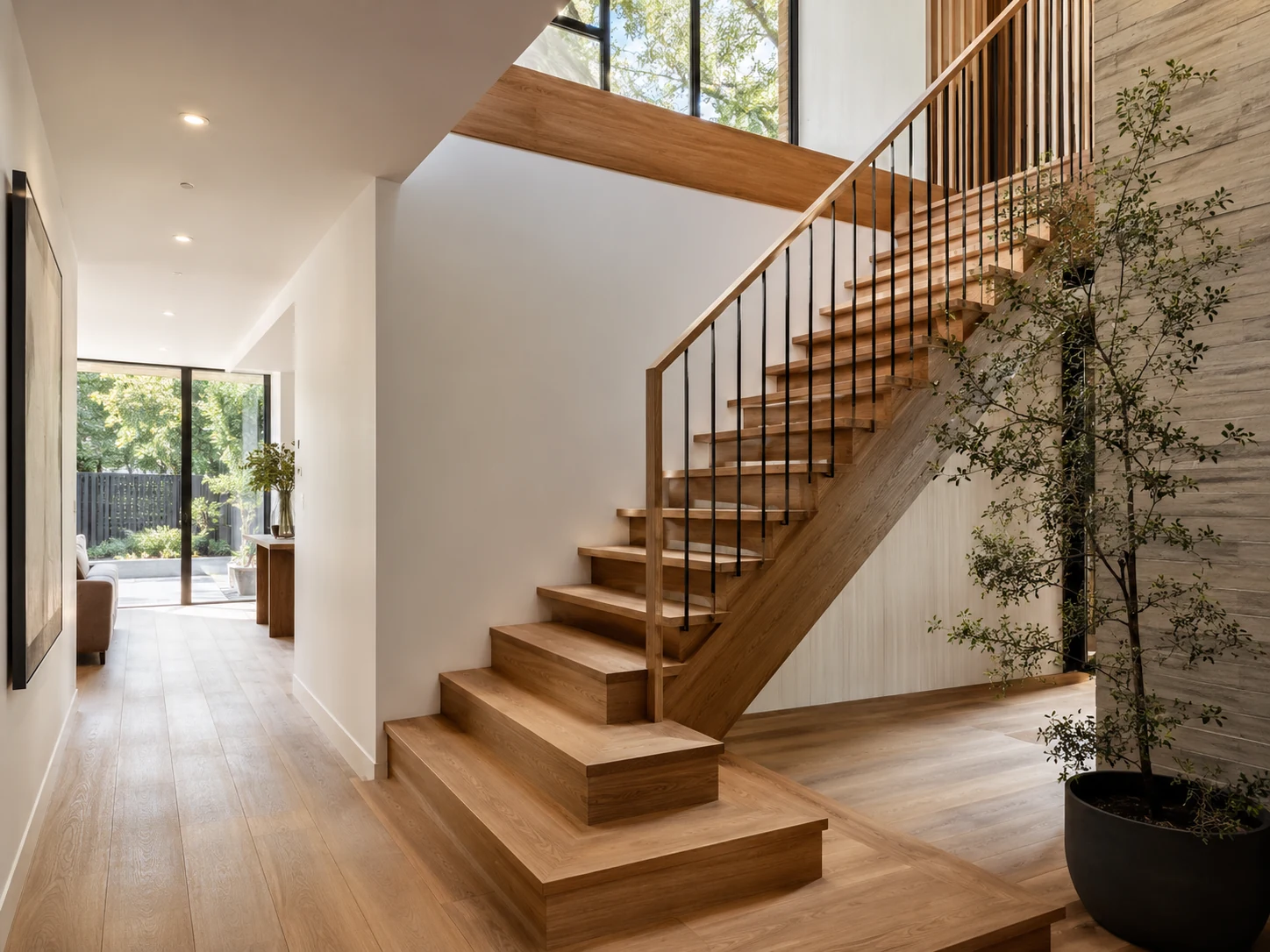
The shape of a staircase is not just a visual choice. It determines how comfortably people move between floors, how much usable space is left for furniture or storage and how safe the route is for everyone in the home. A well-considered layout can make a hallway feel larger, improve privacy between levels and make daily movement more efficient.
The stair shape also affects what is structurally possible in a given footprint. The choice between straight, L-shaped or U-shaped stairs influences where supporting walls may be needed, how natural light flows through the home and how easily building requirements can be met. Selecting the right configuration at the planning stage helps avoid costly changes later.
Before a staircase layout is finalised, the design should be checked against the National Construction Code and relevant Victorian building requirements. Details such as riser height, going, headroom, handrails, barriers and landings can all affect whether a straight, L-shaped or U-shaped layout is suitable for the available space.
Each stair layout occupies floor area in a different way. In compact terraces, townhouses or narrow homes, a straight flight often works well along a wall without breaking up rooms. It creates a clear, direct route that is easy to understand and move along, but it can require significant uninterrupted length.
L-shaped stairs turn 90 degrees partway up. This can tuck part of the staircase around a corner, reclaiming central floor space for living areas or circulation. The turn can be formed with a square landing or with winders, which are pie-shaped steps that save more room but need careful design for safety, comfort and consistency.
U-shaped stairs reverse direction 180 degrees, usually around a central landing. This option condenses the staircase into a relatively compact rectangle, which is useful where floor area is limited in one direction but available in another. The central landing can also help organise adjacent rooms by creating a natural break between zones.
Shape has a direct effect on safety and comfort. Straight stairs provide a consistent rhythm with no changes in direction. That simplicity helps create predictable footing, but it also means there is no natural stopping point if someone trips. For this reason, generous handrails, good lighting and consistent step proportions are especially important.
L-shaped and U-shaped stairs introduce turns and at least one landing. These intermediate platforms provide a rest point that can be helpful for older users, young children or anyone with mobility concerns. In the event of a slip, the landing may also limit how far someone falls.
The corner or turn needs careful detailing. Broad landings are generally more comfortable than tight winders and are often preferable where accessibility, furniture movement or family use is a priority. Handrails, lighting and balustrades should also be planned around the turn so the staircase feels safe and natural to use.
The overall character of an interior is strongly influenced by stair shape. A straight flight can feel bold and architectural, especially in open-plan spaces where the full height of the stair is on display. It creates long sightlines and can frame views to upper floors, feature windows or a double-height space.
L-shaped and U-shaped stairs are often chosen where privacy is important. By turning the stairs, the view from the front door or living area into upper landings or bedrooms can be reduced. The return can also create useful wall surfaces for artwork, storage or doors to adjacent rooms.
Natural light is affected as well. A straight staircase aligned with a window can pull light deep into a hallway. Multi-flight layouts may allow rooflights or high-level windows above the central void, filtering light down through the turns. The chosen shape should work with existing or planned window positions to avoid dark corners and reduce reliance on artificial lighting during the day.
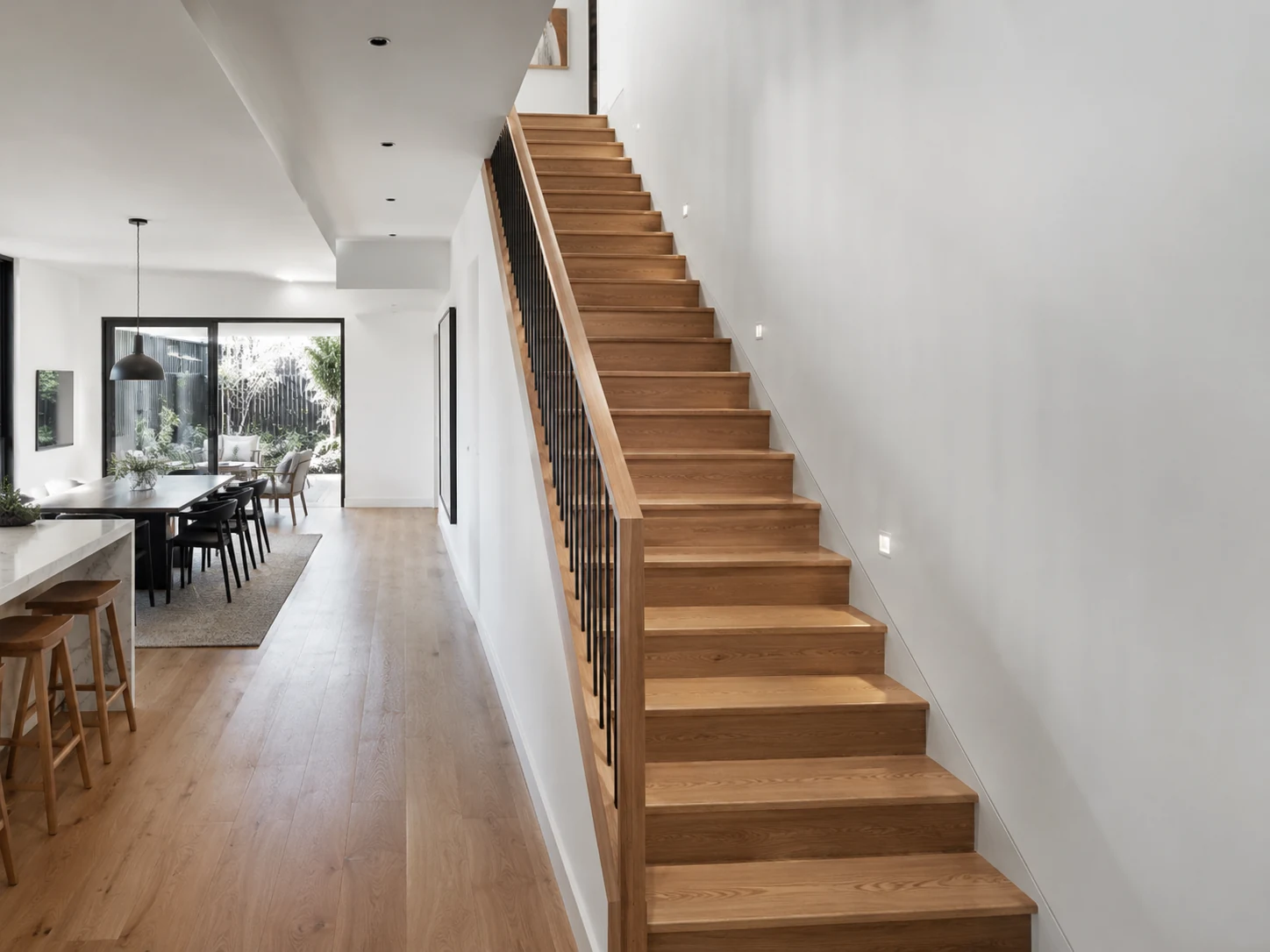
Straight stairs offer the most direct route between floors and suit homes that prioritise a modern look, an open feel and straightforward circulation. With no changes in direction, a straight flight is easy to use, simple to set out and ideal where the staircase can be a feature rather than something tucked out of sight.
This layout works well in open-plan spaces where a single run of steps can sit along a wall, float within a room or connect a hallway to an upper landing without visual clutter. When planned carefully, straight stairs can make a home feel larger, brighter and more connected.
A straight staircase is most effective where there is enough clear length to accommodate the full run without interruption. As a general guide, many domestic flights need several metres of horizontal space, depending on the floor-to-floor height, tread depth, riser height and required headroom. In long hallways, beside living areas or along party walls, this layout can use space efficiently while still feeling generous.
Straight stairs also work well where furniture needs to be moved frequently between floors. The clear run simplifies lifting mattresses, wardrobes and other large pieces that may be more difficult to manoeuvre around turns in L-shaped or U-shaped layouts.
Straight stairs are usually the simplest to design, construct and install. The lack of winders or quarter landings reduces structural complexity, keeping costs more predictable and often lower than more intricate layouts. Joinery detailing is also more straightforward because the treads, risers and balustrades run in a single line.
Lighting is easier to plan on a straight flight. Natural light from a window, rooflight or glazed screen can wash evenly across the stairs, and a simple linear handrail with integrated lighting can be added for a contemporary finish. For families with children or anyone concerned about accessibility, a straight run is intuitive to navigate because it has a consistent rhythm and no change in direction.
Cleaning and maintenance are also simplified. Vacuuming a straight flight is quicker than negotiating corners, and the handrail and balustrade can be inspected in one pass. Any future changes or repairs are usually easier to carry out on a single run.
Despite the benefits, straight stairs are not suitable for every home. They require a noticeable strip of uninterrupted space, which can dominate smaller floor plans. In compact properties, a straight flight can divide a room, reduce usable wall space or limit where furniture and storage can be placed.
Building requirements also affect what is possible. Riser height, going, handrail requirements, landing requirements and headroom all limit how steep or compact the flight can be. Where the available clear length is marginal, a landing or change of direction may be needed to achieve a safe and compliant design.
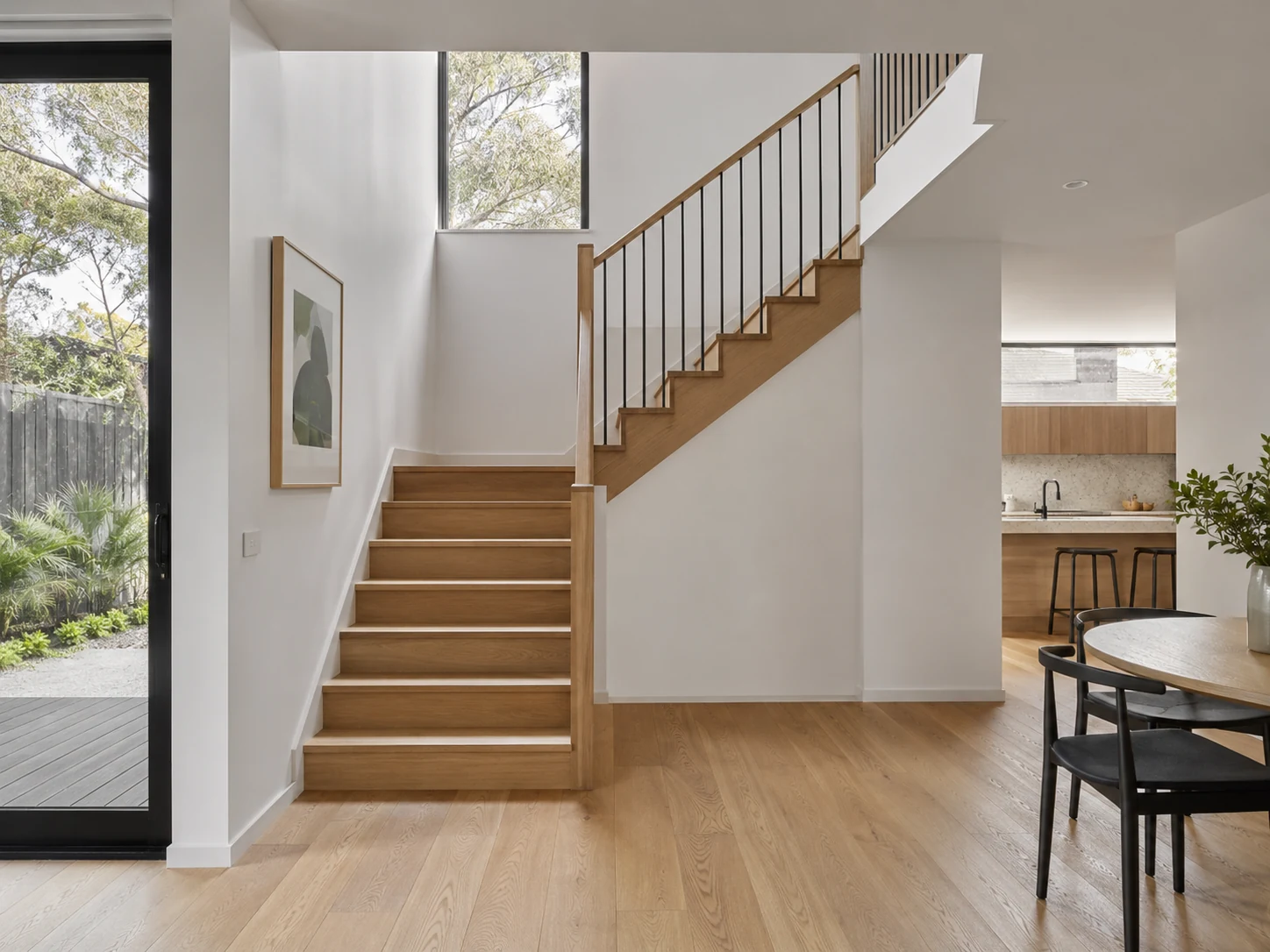
L-shaped stairs use a 90-degree turn, typically at a landing, to connect two levels. This change in direction makes them ideal where a straight run would be too long, visually intrusive or difficult to fit within the available footprint.
By wrapping around a corner, L-shaped stairs can sit neatly against two adjoining walls or help divide zones in an open-plan space. They are often chosen as a balance between efficient use of space, safe movement between floors and a more architectural look than a basic straight staircase.
An L-shaped layout naturally occupies a corner that might otherwise be underused. The run can start along one wall, then turn to follow the adjacent wall, which is useful in entrance halls and smaller homes where floor area is at a premium.
The landing that creates the turn breaks the overall rise into two shorter flights. This can make the staircase feel less steep and provides a place to pause when carrying children, laundry or furniture. Where there is enough room, a landing is often more comfortable than tight winders because it creates a flat, predictable change of direction.
Because the stair hugs the corner, it can leave more uninterrupted wall space for doors, storage or furniture on the remaining sides of the room. Beneath the lower flight and under the landing, there is often useful space for built-in cupboards, a compact home office zone or concealed storage.
L-shaped stairs are highly adaptable. The turn can be positioned at the top, at the bottom or centrally on the run to suit joist directions, ceiling heights, doorway positions and the way people move through the home. The landing can also be enlarged to create a small reading nook or a more generous change of direction if the space allows.
Orientation can be mirrored so the stairs turn left or right depending on the layout. In a long, narrow home, the first flight may run along the side wall, then turn towards the centre. In a more square floor plan, the stairs may turn away from the main circulation route to create a quieter landing area upstairs.
The quarter-turn of an L-shaped staircase softens the visual impact compared with a long straight flight. It can partially screen the upper floor from view, which many homeowners prefer in a hallway or living area. Combined with a feature balustrade, such as timber, metal or glass, the corner can become a strong architectural focal point.
From a safety perspective, the landing is an advantage. It limits the number of steps in a single run and provides a flat space that can reduce the severity of a fall. Handrails can be continued around the corner to guide users, while well-positioned lighting at the landing and along the treads improves comfort and visibility.
Although L-shaped stairs may require slightly more planning than a basic straight flight, they often deliver a strong balance of circulation, storage potential, privacy and design impact. This makes them a practical and popular choice for a wide range of homes.
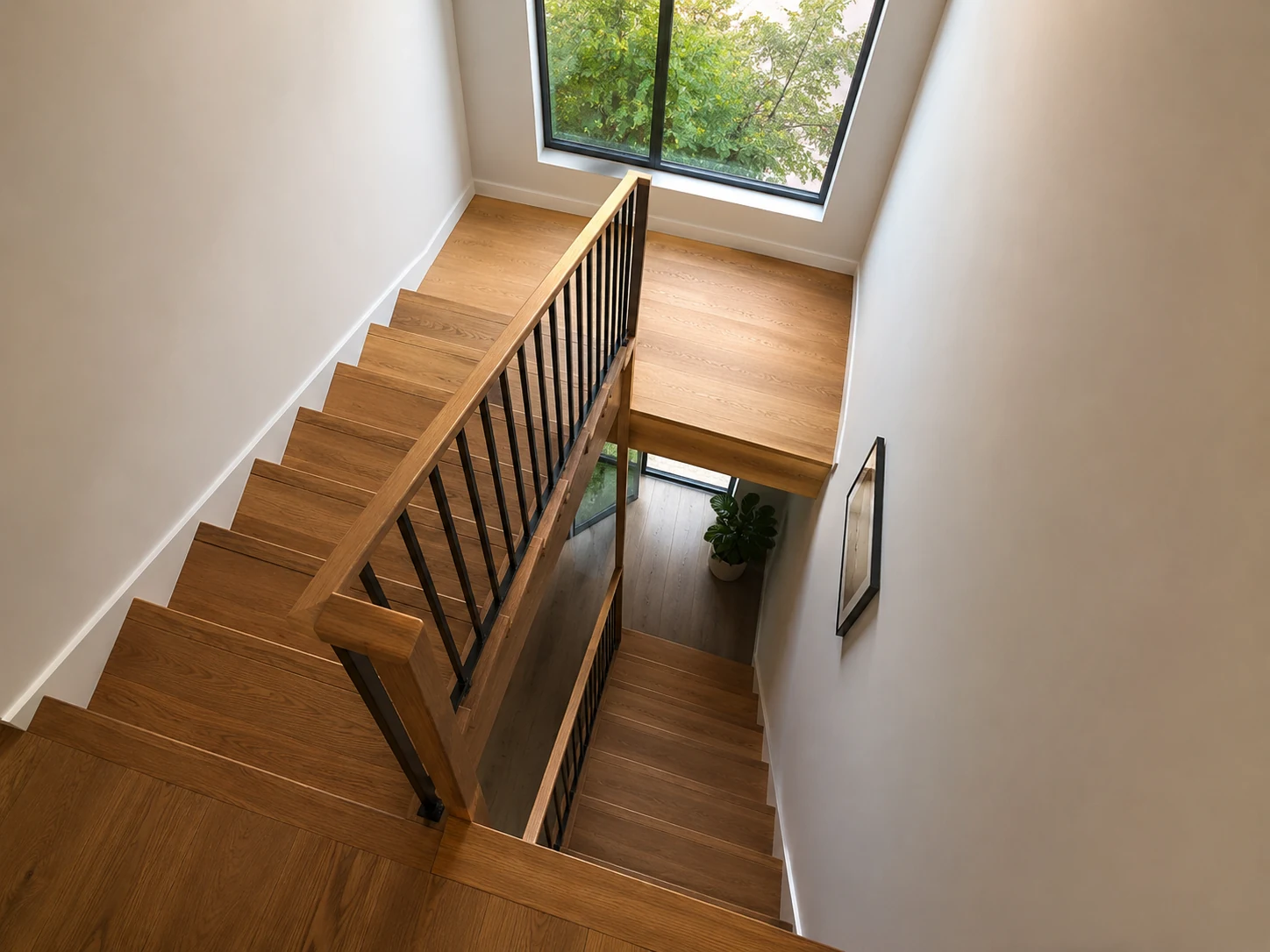
U-shaped stairs, also called half-turn stairs, consist of two straight flights connected by a landing that turns 180 degrees. This configuration allows a full vertical rise to be contained in a relatively compact footprint, making it a strong option for homes where floor space needs to be managed carefully.
Instead of stretching out in one long line like a straight staircase, a U-shaped layout stacks the run of steps back on itself. This creates a compact form that can be tucked into corners, along party walls or into central circulation areas without dominating the floor plan.
The main advantage of a U-shaped staircase is its planning efficiency. By doubling back, it reduces the length needed in a single direction, which can be helpful in narrow, shallow or compact rooms.
In many homes, a compliant staircase needs to manage a full floor-to-floor height while still allowing comfortable risers, treads, landings and headroom. In a straight configuration, this can stretch the staircase deeply into a living area or hallway. Splitting the rise into two shorter flights with a central landing allows the overall shape to fit into a near-square or rectangular zone.
A U-shaped staircase may suit:
The landing can also act as a pause in the layout, making the vertical circulation feel more integrated into the home.
Although compact, U-shaped stairs are generally comfortable to use when correctly designed. The mid-landing breaks the climb, reducing fatigue compared with a single long flight and offering a safe place to stop if needed.
From a safety perspective, the 180-degree turn limits the visual drop compared with a full-height straight run. The solid landing acts as both a psychological and physical buffer. Parents, older users and those with limited mobility may appreciate this break in the ascent.
The central landing can also assist with furniture movement. Large items may be turned on the landing instead of being manoeuvred around a tight corner at the top or bottom of the staircase. Providing a landing depth that suits the stair width and intended use improves practicality.
Although U-shaped stairs are often chosen for practical reasons, they can also be highly architectural. The two flights can sit tight against walls for a discreet, enclosed stairwell or be opened up on one or both sides with balustrades to create a sculptural feature.
Material choices strongly influence how much presence the staircase has in a compact space. Slender steel stringers with open treads can keep sightlines open and suit contemporary interiors. Solid timber flights with closed risers introduce warmth and can make the stair feel more substantial, which may suit traditional or transitional homes.
Lighting the central void with a pendant, rooflight or high-level window can enhance the sense of height and prevent the stair core from feeling cramped. Glass balustrades or open risers in selected areas can further reduce visual bulk without increasing the actual footprint.
Staircase layout affects how easily people move between floors, how much usable space remains and how the home feels day to day. Before deciding between straight, L-shaped or U-shaped stairs, it is important to look past appearance and consider space, structure, safety, comfort and future use.
A well-planned staircase should fit the floor plan, meet building requirements and feel natural to use. The right layout depends on more than preference, so several practical factors need to be considered together.
The footprint of the stairwell is usually the first constraint. A straight flight needs the longest uninterrupted run, so it suits long and narrow spaces, such as along a hallway or wall. L-shaped stairs work well when the staircase must turn a corner between two walls or link different zones. U-shaped stairs concentrate the rise into a more compact rectangle by using two flights and a half landing.
Ceiling height and headroom also affect layout choice. In tight spaces, a turn or mid-landing can sometimes help achieve the required headroom where a straight flight may not work. Existing structural walls, openings and windows should be checked early, as moving them can add significant cost. On upper floors, the stair position also influences where furniture can go and how bedrooms or living areas are accessed.
Every layout must be designed with safety and compliance in mind. Stair design needs to account for tread depth, riser height, consistency between steps, landings, handrails, barriers and headroom. Some layouts make it easier to manage these requirements than others. Straight flights are generally the simplest to set out, while L-shaped and U-shaped layouts need careful planning around landings, turns and any winders.
Comfort is equally important. A comfortable stair has consistent risers and treads, a suitable pitch and enough width for everyday use. Longer straight flights can feel more exposed or tiring, while layouts with landings provide natural resting points and can feel safer for children, older users or anyone with reduced mobility.
Visibility should also be considered. A straight stair gives a clear view from top to bottom, while a turn can slow movement and create a more private route between floors. The best option depends on how the household uses the space.
Staircases strongly influence how light and views move through a home. A straight stair alongside a window can pull daylight deep into the floor plan. An L-shaped or U-shaped stair positioned near a lightwell, roof window or high-level glazing can turn the stairwell into a bright central feature.
Solid walls around turns can create privacy but may block light, so balustrades, glazing or partial openings are often used to keep the space feeling open. The materials chosen for treads, risers, stringers and balustrades also affect how heavy or light the staircase feels.
Everyday use matters as much as appearance. Consider how often bulky items, such as prams, mattresses or furniture, will be moved between floors. Straight stairs are usually easier for carrying large pieces, while tighter turns on L-shaped or U-shaped stairs may restrict movement. Noise transfer is another factor. Stairs that open directly into living rooms can feel intrusive, whereas layouts that turn or incorporate landings can help separate quiet and busy zones.
There is no single staircase layout that suits every home. Straight stairs provide a simple, direct solution that is easy to navigate and often cost-effective. L-shaped stairs offer flexibility, improved privacy and strong integration into a range of floor plans. U-shaped stairs maximise space efficiency and can create a contained, architectural feature within the home.
The best choice depends on your available footprint, structural constraints, safety priorities, design preferences and how the staircase will be used every day. A layout that suits a compact terrace may not suit a large open-plan home, and a staircase that looks appealing on paper may not work once headroom, circulation and furniture movement are considered.
Taking the time to compare each option early can help avoid costly compromises later. Dixon Stairs can help homeowners assess straight, L-shaped and U-shaped stair layouts so the finished staircase works with the home’s structure, floor plan and design goals.

